Author: Kathy King

  • I Promise I Don’t Hate Kids

    When tasked to come up with one thing that every human is universally good at, I’d love to pick something nice. Like being kind, thoughtful, or patient. (Or funny – we should all be so lucky. Imagine a world filled with John Mulaneys!) But in the glaring light of this blog post, not to mention the purposes of my own argument, I’m going to run with judging. Humans are universally good at judging. The more major the subject, task, or behavior, the more intense the judgement. Naturally it would only follow that for women, one of the most prevalent judgements we face is when we decide not to have children.

    It genuinely doesn’t seem to matter why we make that decision, or that of all decisions, this one in particular is the business of absolutely no one but the woman in question. But classic humanity: those very qualifiers obviously make it one of the most widely accepted topics to openly discuss. Prioritizing our careers. Deciding kids aren’t for us. Not being a fan of kids in general. Attempting to stave off overpopulation and reducing our carbon footprints. If there’s one thing you can rest assured when it comes to deciding not to have children, it’s that the majority of the populace will assure YOU that one day, many shriveled years (emphasis on shriveled) down the line, you will regret that decision.

    As a woman that’s fairly sure she won’t be reproducing at any point in her lifetime, I’ve read and enjoyed a large number of snappy comeback lists to just those assertions. Tumblr, Buzzfeed – the internet as a whole is full of them, and they’ve got some great rejoinders. (The internet is also apparently full of renaissance paintings infused with the face of Guy Fieri, something I discovered when trying to find a Mother/Daughter painting for the header of this post. Please go look at them.) Every list makes me laugh, but a friend linked one on Facebook a few weeks ago, and about six GIFs in, a nascent response from a fellow frustrated woman actually gave me pause. It mentioned that her least favorite presumption about us is that women that choose not to have children must, clearly, hate children.


    There aren’t a lot of decisions in the modern world that you can’t unmake. Your career, your education, your streaming subscription. Your marriage. Having pets. Buying a house. Short of those sins that come with a life sentence, pretty much anything can be reversed. But not having kids. That’s fairly obvious, right? Given that certainty, given the inescapable level of commitment that comes with having children, it’s kind of insane that choosing to have kids is a presumptive societal default. Really, it should be the reverse. Unless you’re absolutely over-the-moon certain that parenthood is for you, maybe we should encourage people to hold off.

    There’s no longer a question as to whether humans will survive (well, that’s not entirely true, but let’s just say running out of humans isn’t exactly our problem anymore). So why do we cling to the idea of everyone needing to have children? If anything, we should be grateful that some humans are willing to take one for the homo sapiens team and say “yeah nope” to progeny in general. But a practical argument is hardly guaranteed to stand up against these expectations, so it can be hard to be one of the women that “yeah nopes”. And like any circumstance when you’re judged unfairly, the most hurtful part of it is the conclusions people inevitably draw.

    I couldn’t give a shit that you think I’ll regret this in ten, twenty, thirty years. But I really wish people would stop thinking that just because I don’t want kids, I think they are the eleventh plague, that I’d rather die (or at least grimace) than hold a baby. Maybe, y’know, I’d just rather be Auntie Kathy than Mom. After all, being Mom is a helluva lot of responsibility. All of the things we lightly joke about on those rejoinder lists I’m actually quite serious about. Sure, I’ll never know the love of my own child, but it’s not going to kill me. The risk of what could happen if I did have kids and regretted THAT decision ten, twenty, thirty years down the line is potentially far more painful.


    So we’ve covered the fact that you can’t just assume I hate kids because I don’t want them. But something a lot less talked about, that is actually almost more of deterrent than the kids themselves, is how much I don’t like moms.

    There. I said it.

    It’s not quite that simple, because I don’t dislike all moms. Very far from it! Most moms are pretty great (shout out to mine, she’s one of them). But some moms…whoof. Some moms act like the primary requirement to joining their Motherhood Club is an enduring and unquestionable sense of self-righteousness. I just do not think I am ready to deal with that. I have no interest in being dragged into parenting strategy discussions. No interest in the judgement, almost more severe than what I would have faced had I not had children, that eventually follows when you meet a mom that doesn’t think you should be giving your kid potato chips. And I know. I KNOW: “You’ll never understand because you don’t have children.”

    Well, in the words of Chuck from Sons of Anarchy, I accept that.

    There are other ways to use the energy that mothers expend on loving their own children. I can’t argue that they’re equally fulfilling, but I would argue that they are equally admirable. Working with youth that don’t have supportive family systems. Fostering. Adopting. Volunteering. Or going to the other end of the spectrum – all of those people filled with decades upon decades of gut-wrenching and hilarious stories of their own, sitting in group homes with a weekly visit from family at most. Visiting them, talking with them, keeping them company. There are so many humans out there to love.

    Do I do all of those things? Absolutely not. (Is it physically possible to be that saintly?) But should I feel that I have an unused portion of my heart come my older years because I chose not to have my own kids, I am quite certain in my knowledge of my own spirit that engaging in any of the above would go far to make up the gap. Beyond that, I already have the luxury of (nearly!) two nieces to dote on ceaselessly. Somehow I doubt they’ll begrudge having an extra benefactor should it come down to it, and from what I’ve been given to understand, the Aunt Club is just a touch more chill than the Mom one.


    I am so excited to hear when my friends decide to have children and become mothers. I can’t say I’m passionate about changing diapers, but I’m happy to help and laugh when it’s an awful mess (Huggies are not my strong suit). I do think we should be more aware of how many more people this planet really needs, but I don’t believe restricting how many kids people have is the answer.

    I hope people are equally less judgmental of my decision to go childless, however much judging is their forte. I mean, maybe I will change my mind in ten minutes or three years. That’d be just fine too.

    Because when it comes down to it, there are no wrong answers to whether or not a woman wants to have children. But there is definitely a wrong way to respond.

  • Grief, Or Something Like It

    There are phone calls, and then there are phone calls.

    The second kind become great, memorable divides, minutes-long exchanges that separate Life Before and Life After. They’re the kind that tell you about something that’s already happened, while you’ve been blithely unaware, and suddenly the world shifts. You can’t unhave them and you can’t forget them. Saturday, July 27th, I got the second kind of phone call from my sister. Two transatlantic flights, one attempt to go back to work before I was ready, and some bone-deep jet lag later, I’m still coming to terms with the fact that my dad has died.


    When I went home to visit my family last February, I decided well in advance that I would try to specifically get my dad to engage. He was living with my mom and sister in Georgia and they were taking care of him, a task that became more mammoth as his Type II Diabetes (and stubborness) wore on. His behavior was the same unchanged pattern of the last seven trying years: solving puzzles online, reading articles online, and watching Netflix. Determined to squeeze something else out of him in the six days I visited, and with the resiliance of spirit of someone that didn’t have to deal with his increasingly difficult personality every day, I brought the game Catch Phrase.

    My family has always been terrible at enjoying each other’s complete company. Terrible is a strong word, but the truth of it is that there aren’t a lot of situations where all five of us in the same room ends up being much fun. But the surest fire way to achieve fun throughout childhood was a good card game. It was how my parents had passed their honeymoon and it was still a solid strategy three daughters later. Catch Phrase wasn’t a card game, but I thought it was a better bet, because it forced conversation. You can’t play Catch Phrase – basically $100,000 Pyramid in a pass-around electronic form – without talking to each other excessively. Ideally, also, it would involve a whole lot of laughing.

    Skeptical at first, my dad eventually acquiesced and the four of us sat in the living room, listening to John Anderson, playing Catch Phrase. And I will be forever grateful for that stupid little game, because in those few nights, I saw more of the old dad I remembered than I had seen in years. Sure, before and after he was unchanged, returning to his room and his puzzles once we’d finished. But the during – his thoughtful descriptions, his raised eyebrow at our own, less-than-thoughtful ones, the gleam of genuine amusement and following laughter when the buzzer went off the second he handed the game to my sister – the during I’ll remember forever.


    My dad was a wildly successful workaholic for the majority of my childhood. He’d been a regular full-time employee in the IBM-led tech world of the 1980’s before I was born, but for my entire memorable existence he’d been a charismatic contractor, selling his expertise to assorted companies across a variety of sectors. His contracts would take him all over the county, oftentimes all over the state, and they always paid him very well. My dad loved providing for his family and was fiercely passionate about it; he derived the majority of his joy in life from work, the sense of purpose and affluence it gave him, and most importantly, his ability to support his family. What he didn’t get from that (or our love, of course), he happily got from eating extraordinarily well. My dad was a big guy, and it took big food to keep him that way.

    There wasn’t much that stopped him, either, regardless of what he wanted. He had a steel will that was terrifying to behold, and not just as his child. I imagine dealing with my father in the workplace could be as horrifying as it was inspiring. He had a zero-tolerance policy for bull shit – a life motto of “No Surprises” and “You Can’t Fix Stupid” – that even extended to being too silly in the car. (During an ill-advised family road trip to Louisiana, one of only two such family vacations we went on in my entire childhood, we lost the privilege of going to a theme park on the way due to excessive silliness in the car.)

    In a family with a 4:1 female-to-male ratio, you’d think we would have ended up a pretty emotive, demonstrative bunch. But that was far from the truth. I never, ever doubted that my dad loved me. How he chose to show it, though, was in the way he provided for us, in the experiences he could give us, and from time to time, in a charming affability that made us realize that while poorly-timed silliness on our terms was something he had little patience for, silliness on his own terms was something he enjoyed sharing with us very much. The way my dad expressed love was usually never through words, and, not in the hollow way it sounds, almost always expressed through money. Taking us out to dinner. Paying for our favorite clothes and toys. Buying me an oboe after he’d just bought me a flute because I had the instrumental constancy of, well, an eleven year old. Dad loved us by spoiling us, and he loved it well.

    An imposing six-foot-three inches, confident, mustached, the definition of the sort of gentleman that can only buy his suits at the Big and Tall store: that was the guy I grew up with, and I was often in awe of him. We didn’t talk about a lot, but I loved listening to him, and most of my young memories of him are more of just going on rides with him than anything else. (He was a major fan of driving.) My sisters and I spent many an hour standing behind his office chair, peering at his computer monitor over his shoulder, impatient for him to finish explaining his newest Excel spreadsheet. And while we didn’t always have the same opinions, we could always be sure he would share his, and he always spoke with authority and inflection on most any subject at hand. He could sear you and your opinions with a look.

    I share all of this so you can understand just how hard it was to process the person he became after 2008, the person I visited last February.

    Between the sudden death of his best friend, who was almost ten years his junior, and the economic recession, which slowly saw the last of his contracts permanently dry up, my dad was a vastly different person from 2008 onwards. Never a man of many hobbies, with no work to keep him busy, he became a recluse, hyper conscious of the family budget and more inclined to spend time looking up minutia on the internet than to spend it speaking with any of us. Despite numerous efforts to network, he continually struggled to find any new jobs. Eventually he just stopped looking.

    It sounds so simple in hindsight, but it took us years to realize he was depressed, and years more to talk to him about it. But by the time we did, it was too late. Maybe because he thought it was weak, maybe because he genuinely did not think anything could be changed, maybe because he simply did not have the wherewithal to try – whatever his reasons, he never did anything to try and fix it. For seven years, it got progressively harder to keep the faith that he would ever manage to. From the moment I got that phone call from my sister, I realized a harsh truth: now, he never would.


    Losing your dad is never easy, but my dad’s health had been waning for years, and he had not been “himself” for a decade. I genuinely thought I had done most of my mourning for the person that raised me, because so much of him was already gone. Boy, was I wrong. I hadn’t realized that however much I had accepted where he currently was, that was NOT the same as him being gone. While he was still alive, there was still a chance – however impossible, however small – that he would rally. That the dad I had grown up with, dynamic and confident and charming and vital, would come back. I don’t think I will ever stop being sad that he just couldn’t. Because of his depression.

    Worse, it hurts that he never felt like he could talk to us about it. I would have given anything to lend just five minutes of my own drive and self confidence to my dad – from whom, through both nature and nuture, so much of those qualities were sourced – to get him to see he had the strength to get through it. To see that it wasn’t weakness to talk about it, that we absolutely knew he still loved and cared about us. To see that he didn’t need money to prove it and that all we wanted was for him to express it through words. All we wanted was a conversation about something other than the weather, a day spent on something other than puzzles and streaming more NCIS.

    My dad had advanced Type II Diabetes, Congestive Heart Failure, and was severely overweight. He passed peacefully in his sleep on a Saturday morning from a combination of his physical ailments. But I would argue that depression was his deepest illness, and that I couldn’t help him with it will always be one of my deepest regrets. I have my suspicions, but the truth is I’ll never know what it was that stopped my dad from being able to share what he was going through. All I know is he was painfully good at faking otherwise – he was always “doing good”. So in his memory, I want to take the time to say that if you are reading this, and you are “doing good”, you may not feel ready to talk about it yet. But I want you to know that when you are, I am someone that will always be here to listen.

    I didn’t know how to help my dad and so I settled for telling him that I loved him, showing him that I loved him. It wasn’t much towards the end – if I could change how often I called him over the last year, God you know I would – but I know as much as you can know anything in this life that he knew he was loved. Sometimes that is the best that you can do.


    It sounds stupid, so basic, but the strangest part of death is that no matter where you go, you will never find that person. No matter where you go. But there is a constant comfort in memories, perfect and imperfect, and while I will be sad for a long time, I will also be okay. I will move forward and eventually stop having those cutting, random thoughts – that my dad won’t ever know the person I marry, that he won’t get to see my neices grow up – and realize that for my dad, this was the best case scenario. More than anything, I will always be grateful for the time I did have, and everything wonderful he did give me. Because old those memories may be, but they will never fade, nor will their impact, nor my image – strong, dynamic, and loving – of my dad.

  • Three Fave Books Right Now

    Need a new companion for your daily commute? We’ve got you covered in three very different directions.


    Americanah – Chimamanda Ngozi Adichie

    I picked this book up on a whim at Foyles and didn’t realize until I was halfway through that I had encountered a clip from a Ted Talk by author Chimamanda Ngozi Adichie in my newsfeed a few weeks earlier. In it, she lightly but thoroughly tackled the racist preconceptions a college roommate had about her home country of Nigeria (go watch The Danger of a Single Story). I’ve since learned you can’t go wrong with reading anything Adichie puts to paper.

    In many ways a story about how some connections and relationships both define and never leave you, Americanah is stunning from its tangible main characters, Ifemelu and Obinze, to their experience of culture and race in several settings, to the vibrancy of those settings themselves. Whether it’s the streets of central London, an American hole-in-the wall hair salon, or a crammed outdoor food market in Lagos, Adiche’s descriptions satisfy every sense, instantly transporting you as needed. Given the far-reaching global stage of Ifemelu and Obinze’s stories, that’s quite a feat.

    Bonus: if, like me, you enter the novel unfamiliar with the music of Onyeka Onwenu, you’ll exit it with the IMPOSSIBLY FUN Living Music stuck in your head for days.


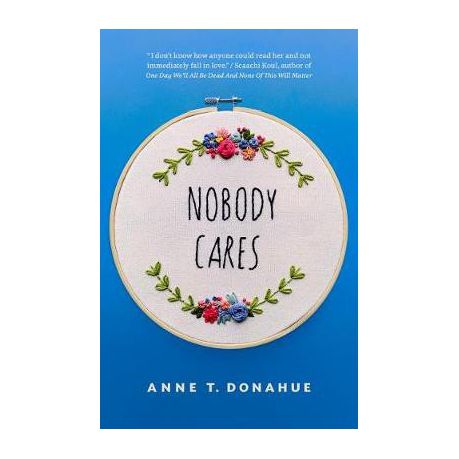
    Nobody Cares – Anne T. Donahue

    A totally different timbre from Americanah, Nobody Cares is a collection of zingy and heart-felt essays by Canadian author Anne T. Donahue. I owe my knowledge of this particular author to my shameless continued use of Tumblr, and am the better for it. I now follow her on Instagram and was duly aware (and thrilled) when she debuted her first book, and I grabbed a copy as soon as it was available in the UK.

    When you need a sharp, funny, ten page pick-me-up, from social pressures, to mental health, to dealing with the best and the shittiest friends and life circumstances, you can do no better than sitting down with any one of the essays in Nobody Cares. It’s like having a motivational speaker in your bag. It may be a motivational speaker that functions a little like a quirky, snarky aunt stuck in the late 60’s, but as Anne’s Insta will attest, she’s the first to admit that. And as I will attest, it’s an absolute blast.


    Matilda: Empress, Queen, Warrior

    Most people don’t think historical reading is accessible, and most of the time, I can agree with you. A lot of it isn’t. But books like Helen Castor’s She Wolves have popularized a more digestible version of history books, valiantly outshining those of the past that rock that strange dichotomy of theoretically, deeply fascinating material, but literally, written in a way that’s anything but. Catherine Hanley’s fresh biography of my favorite local 12th century feminist is happily of the She Wolves vein.

    Hanley walks us through the entire life of the Empress Matilda, from child-bride of the Holy Roman Emperor to Queen-of-England hopeful in her own right. Better yet – especially since Matilda’s story is so unknown and difficult to detail based on the male-leaning chroniclers of the time – Hanley’s writing is well-researched, always stuck firmly in the female perspective, and best of all, just fun. Hanley is insightful and funny, sharing Matilda’s experience as Empress, Queen, and Warrior in an engaging, contemporary style without getting bogged down in the twelfth-century details. (Favorite line: “..Matilda gave birth – to her immense relief – to a healthy son. In one of the least surprising moves of the Middle Ages, the boy was named Henry.”)

    If you’ve been avoiding history books until now, I urge you to dive headfirst in with this one.

  • Bio Pages Are the Worst

    First off, cards on the table, I’m writing this about myself. All-powerful-Oz reveal. So, if I go and write an entire bio page about myself in the third person, it feels unutterably pretentious. Whether or not that’s true, or if the queasy pompous- feels it triggers are really an impostor syndrome flare up, is up to the internet jury.

    Instead of waiting for feedback I’m going to listen to Laura Branigan’s Gloria and write a weekly blog post that will for the foreseeable future function as my contributor’s bio page* for Viv + Kit. (I am already so into this idea that I think this will be the policy for all new contributors. The Laura Branigan part will be encouraged but optional.)

    *Editors note from 25/10/20 – this is now somewhat outdated, primarily due to the fact that my career went full dumpster fire at the end of 2019 and I pivoted accordingly


    Orange County born, Sacramento raised, and a jure sanguinis dual Italian American citizen, I’ve lived in all the best parts of California (I’m looking at YOU, San Diego) and now call London home. Day-to-day I’m head person in charge at Anthropologie’s flagship European store on Regent Street.

    Viv + Kit was borne of a desire to not only create and write on the regular, but to try and be a bright spot in any single person’s day, one post/list/essay at a time. You’re not going to find any Great Gatsby sort of authorship under my name, and I don’t know that I’m capable of changing anyone’s life or perspective in a major way. But if I can throw together a niche favorites list or snappy diatribe on how I think you should judge your success versus how society does that elicits just ONE laugh or smile, then I’m all about it.

    I used to really beat myself up because I felt like even post undergraduate education, I didn’t know “a lot” about anything. Like, most English Lit majors may not have a career waiting for them on the other side of that graduation ceremony stage, but at least they could walk you through Paradise Lost. No such luck here. When I was 22, the thing in life I knew the most about and was the best at was the “hip” import retailer Cost Plus World Market – real talk. I started working there as a cashier out of high school in 2007 and returned to the life when six months of dallying with the real world got me (and my degree) nowhere.

    Making a career out of retail has been a JOURNEY for me, mostly because I hate the idea of doing something other people don’t think is cool. (If you didn’t think I was basic before, there you have it. I’ve got the career aspiration equivalent of a pumpkin spice latte.) I derived the majority of my self worth for years out of what my job was, and for someone who viscerally remembers standing in the stock room of her old World Market, deciding to sign on for $30k in college debt because she REFUSED to be stuck in retail forever, having a career in retail was some Old Fashioned level bitter gall.

    But I’m exceptionally lucky in my skills and my interests (and my flawless aesthetic, I tell myself), because once I developed enough as a person to realize job status does not equal personal value / a job is a job no matter how you slice it, the two combined to land me in a career that’s ironically taken me everywhere I could’ve asked for.

    I was just biding my time while my dual Italian American citizenship stagnated when my District Manager approached me about becoming a supervisor with World Market. Two years later I was a Store Manager when a customer, who apparently worked at Anthropologie, recognized that my pants were from Anthro, and reached out to recruit me when I impressed her with my service. I worked for Anthro for two years and then it gave me the perfect in to move back to the UK, a goal I’d had since the second I left Norwich after university and had all but given up on by 2017.

    While customers, yes, can be challenging (when they’re not recruiting you), what nobody tells you about retail is that it’s like any other job – it’s defined by the people and what you put into it. I’ve worked with a handful of characters that I could happily do with never seeing again, but for the vast majority of my career I’ve had the pleasure of working with and learning from some most excellent specimens of human cool. In retail, there’s a 50/50 shot that every one of your coworkers has a side-hustle they wish was their main hustle – who, after all, would actively choose retail, is the running joke – and those side hustles are always fascinating.

    Over the years and with the help of some absolutely stellar professional mentors (Ed, if you’re reading this, you are still my hero), I’ve become a really great retail manager, and I genuinely enjoy it.


    Given all of the above, a lot of what I write comes from a place of self criticism, weighing my own values and journey against those of society, trying to take life a little less seriously, and reveling in and laughing at all of the conclusions I draw from my rose-colored view of my past and potential future. When you read something I’ve written, it’s likely to be laced with at least one of those concepts. I like to think of myself as an unlicensed authority on them.

    Other things I’ll chalk up as interesting qualifiers: experience living abroad and far from my family (not once, but twice!), unparalleled skill at quoting/making very specific pop culture references, and overusing a new word every 3-4 years. Ten years ago it was “epic”. Right now it’s “niche”. I enjoy making people laugh and I enjoy immersing myself in good music, fun pop culture lists, great fashion, highly-specific history subjects, and anything well-written. So it should surprise no one that I’m the founder of this website.

    My greatest fear is that when I write I’m like Midge Maisel telling her manager Susie that working every dinner party she can snag an invitation to is the same as successfully working an actual comedy club crowd. But let’s be honest. If that’s what’s happening here, there are worse people to be than Midge, center stage in someone else’s living room, making her friends and borderline strangers laugh. (Right…?)

  • Three Fave Underrated Chick Flick Leads

    Fine, not all of three of these gals are the leads – you got me. But you can leave that negativity at the front door and read on anyway, because I assure all three women are worth watching.


    Loretta Castorini – Moonstruck (1987)

    Cher is an icon. So you’d think it would be impossible for her to play a role where you don’t first and foremost see her as, well, Cher, right?

    Enter her Oscar-winning performance as Loretta Castorini. We’ll skip past the fact that this is also one of Nic Cage’s best performances (and best lines – “A BRIDE WITHOUT A HEAD” comes to mind, but “and I bake bread, bread, BREAD” stands out too) and focus instead on Cher. Moonstruck, one of the best romantic comedies knocking around the genre, starts off with 37-year-old widow Loretta’s engagement to raging milksop Johnny Cammareri, but the action really starts when Loretta takes it upon herself to invite Johnny’s one-handed younger brother Ronny (Cage) to the wedding.

    Loretta landed on this list because she works with whatever comes her direction with a woman’s particularly unquestioning efficiency. What’s happened to her has happened to her and she’s making the best of it. This skews her priorities a little from the get go, with a staunch superstition that all be done to a traiditonal T to avoid the bad luck she’s experienced through most of her life, but as in all good stories, that flaw turns out to be the driving force and undoing of the plot. Loretta is sweet but uncompromising, leaning heavily into her family and relatably struggling with a divided loyalty between her straying, mid-life-crisis father Cosmo and her supportive, sarcastic mother (played in another epic casting turn by Olympia Dukakis).

    Cher (that HAIR) & Nic Cage (those CHEEKBONES) in Moonstruck, MGM

    Mostly I am endlessly envious of Loretta’s PEAK 80’s makeover before her hot date at the Met, but having the strength of character to plant both feet on the ground, resist any ounce of self-pity, and a perfectly-timed, life-changing, post-opera decision to side with romance over reason are other strong contenders for why I wish I could be Loretta Castorini.

    Other Reasons to Just love Moonstruck Anyway:

    The entire film is quotable (“Old man, you give those dogs another plate of my food and I’m gonna kick you ’til you’re DEAD”; “Birds fly to the stars, I guess.”), its Italian-American/Brooklyn aesthetic cannot be overvalued, the entire adorable date between Olympia Dukakis and Fraiser Crane’s dad.


    Kate – French Kiss (1995)

    It could be argued that Meg Ryan single-handedly kept the chick flick alive straight from When Harry Met Sally on through You’ve Got Mail. Sure, she clearly got dead tired of it (see Proof of Life, In the Cut, and Against the Ropes for reference), but even that neck-cricking 180 can’t diminish the strength of her prior performances. And I’m here to tell you that, You’ve Got Mail fan girl I am, her turn as Kate in French Kiss is the best of the bunch.

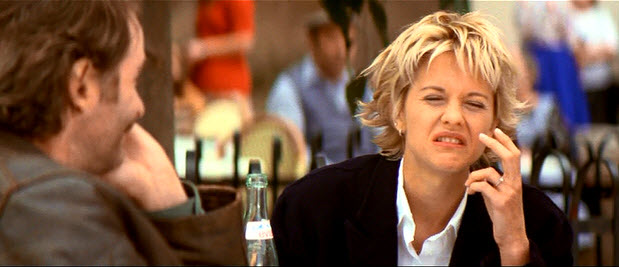
    French Kiss flew a bit under the radar, most likely due to the fact that Ryan wasn’t starring opposite Tom Hanks, but her Kate to Kevin Kline’s Luc is a snappy, sarcastic example of great chemistry. Kate, eyes scrunched, uttering the line “All men are bastards!” and, moments later, “Of course you know him! All you bastards know each other!” remains one of my favorites.

    Meg Ryan (and kind of Kevin Kline), getting her squint on, 20th Century Fox

    But more than her connection with Luc, I love Kate because of her transition from relationship-reliant to strong solo female. Sure, she ends up with Luc in the end (on their own vineyard in Bordeaux, no less), but not before she decided she was perfectly happy ditching the fiance that had already ditched her when he comes back, tail-between-his-hella-90’s-dressed legs, and flying home on her own.

    Kate also spends a lot of the movie associating her geographic home with her identity as well. In the process of gaining Canadian citizenship, she considers herself no longer an American, and when an embassy worker denies her that treasured maple leaf flag, she later declares herself “currently without country”, somewhere between proud and self-satisfied at how much it no longer matters. If you’re struggling with getting outside of your comfort zone or with re-defining what defines you, a girl can do far worse than using the strangely-rootless Kate as a role model.

    Other Reasons to Just Love French Kiss Anyway:

    Bizarrely excellent 90’s French soundtrack (featuring Kevin Kline singing La Mer), specifically mid-90’s French fashion/aesthetic, Jean Reno, the entire exchange between Kate and the concierge at the George V.


    Patti – Under the Tuscan Sun (2003)

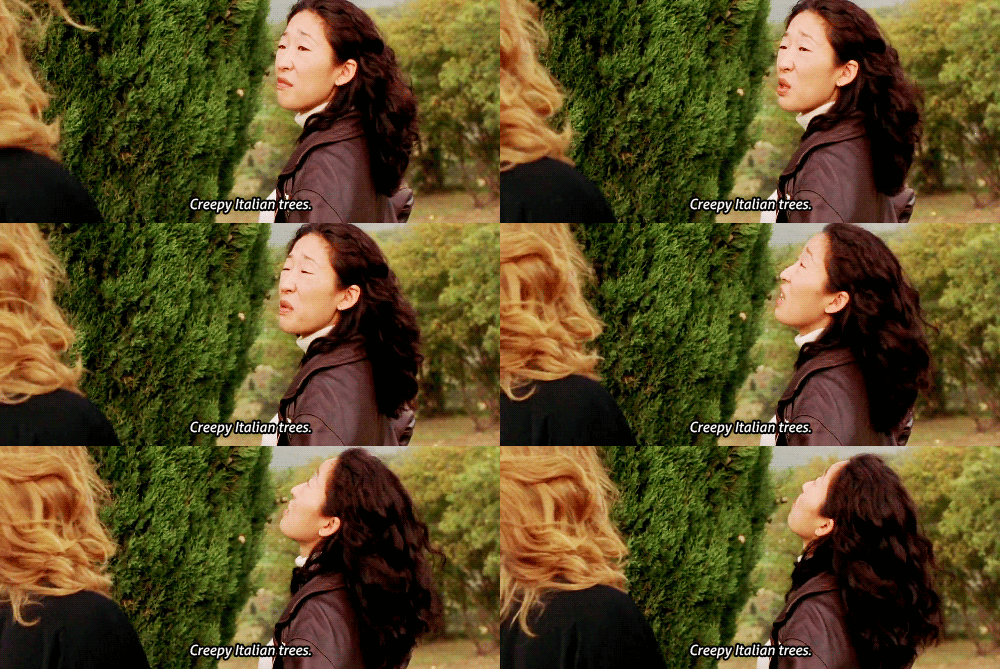
    I know, I know – Diane Lane’s Frances is supposed to be the protagonist of Under the Tuscan Sun. But after watching this chick-flick staple hundreds of times over the years, I’m here to tell you the truth: Frances’ pregnant, jilted, lesbian best friend, played impeccably by Sandra Oh, is this film’s true hero.

    It’s easy to get confused about this, as Diane Lane did get top billing, and Patti fulfills many best friend/side kick tropes. She bestows Oprah-like advice about the crossroads of Frances post-divorce life, she provides emotional support when Frances doesn’t exactly cope, and she delivers zingy-one-liners about Frances’ shitty ex and her comical new situation in Tuscany. But what Patti does even better than this, and does better than Frances, is rise from the ashes of an absolutely shitty set of real-life circumstances when her long-term partner leaves her when she’s seven months pregnant with the baby they’ve been trying to have together for years.

    Talk about an excuse to quit life. I can’t imagine something scarier than facing parenthood on your own when every expectation is that it’s the last thing you’ll have to do. But Patti eats her words about how probably not great an idea it was for Frances to have bought a villa in Tuscany and instead, in her own moment of cheesy Oprah crossroads, ditches San Francisco to join her bestie there. Yeah, it’s peak Hollywood privilege to have that kind of fallback plan, but it’s still pretty brave for Patti to even in those circumstances power through and have and keep the kid she’d been planning on raising with her ex. If I can handle even one life crisis with the humor and humility Patti does, I’ll consider myself a success.

    Sandra Oh, being great, Touchstone Pictures

    Other Reasons to Just Love Under the Tuscan Sun Anyway:

    That goddamn Tuscan scenery (plus two Positano cameos), “D’you want to come over?” “…maybe later?” FACEPALM, Patti swoop-dancing with the baby amongst the trees, “Okay, yes” and the entire Polish construction crew, everything utterly ridiculous Katherine (the inimitable Lindsay Duncan) does.